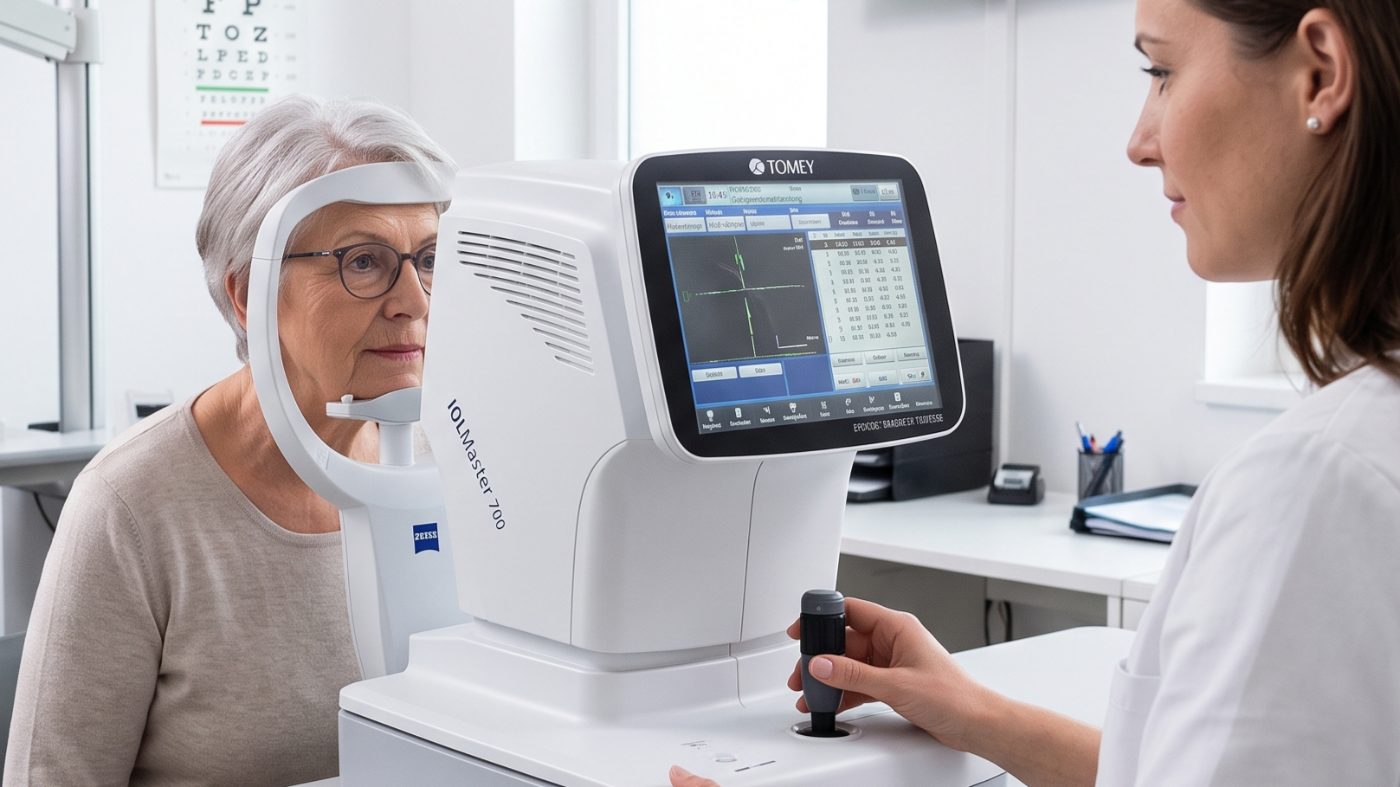
The day of surgery: from arrival to discharge

A cup of tea in the still-quiet kitchen, with dawn only just breaking outside. That is how the day of cataract surgery begins for many patients. Cataract, a clouding of the eye’s natural lens, is removed in a procedure that itself usually takes only 10 to 20 minutes. Even so, two to four hours typically pass between entering the practice or day clinic and being discharged, because preparation and observation take more time than the operation. Here is how this day typically unfolds.
8:00: Arrival, check-in and the first drops
You arrive at the agreed time, usually in the morning. At check-in, your details are verified and any last organisational questions are settled. Your ID, your e-card (the Austrian health-insurance card) and your current medication list belong in your bag. Some practices briefly run through the key points of the day again at this stage.
Then comes the first medical step: eye drops to dilate the pupil. They need about 20 to 30 minutes to take full effect. During this waiting period, further preparatory drops may be added, for instance anti-inflammatory or anaesthetic ones. Many patients find this phase the longest of the day. An audiobook brought from home, or a chat with your companion, makes the wait shorter.
9:00: Preparation and anaesthesia
In the preparation room you are asked to change, or to wear a surgical gown over your clothes. The eye and the surrounding skin are disinfected. A sterile drape covers the face except for the eye being operated on. The other eye stays free, so you can breathe easily and keep your bearings.
For the great majority of operations, anaesthetic eye drops are enough. An injection or general anaesthesia is needed only in exceptional cases, for instance with particularly restless patients or complex findings. With drop anaesthesia you feel no pain during the operation, but you remain awake and responsive. That has a practical advantage: brief instructions such as “look straight ahead” are easy to follow. Coughing or small movements are no problem either, if you let the team know in advance. The surgeon then pauses briefly.
9:30: The procedure
In the operating theatre you lie comfortably on your back beneath a microscope. The surgeon opens the lens capsule through a tiny incision, just a few millimetres wide, at the edge of the cornea. Using ultrasound energy, the clouded lens is broken up and suctioned away. This technique is called phacoemulsification. The surgeon then inserts a foldable artificial lens, which unfolds by itself inside the capsular bag.
What do you perceive during all this? Most of the time you see bright light and blurred movement, but no sharp image of what is happening. Some hear soft sounds from the device. Many describe the light as colourful, moving patches, rather like a kaleidoscope. You should feel no pain; slight pressure is possible and considered normal. When the artificial lens is inserted, some notice only a brief shift in the light impressions.
10:00: Recovery area, check and discharge
The incision is designed so that it usually seals itself. A stitch is generally not needed. A light dressing or a protective shield covers the eye for the first hours or overnight. After a short period of monitoring you move to the recovery area, where staff check that everything is progressing normally.
Usually you may get up and dress again after 30 to 60 minutes. Before discharge you receive precise instructions on the eye-drop schedule and an appointment for the first follow-up, usually the next day. Use these minutes for any last questions about the drop schedule or the first days at home. You can usually see straight after the operation, though blurred at first. A noticeable improvement often sets in within the first 24 to 48 hours.
You do not drive yourself home. Arrange to be picked up or use another means of transport.
When the second eye follows
In most patients, only one eye needs treatment at first, or one eye shows markedly stronger symptoms. If the second eye is affected too, the second operation usually follows one to four weeks after the first. This interval has a practical reason: only once the vision of the first eye has stabilised can the result be judged reliably. That experience feeds into planning the second procedure, for instance in choosing the lens power.
The second day of surgery largely mirrors the first. Many report that the second appointment felt less nerve-racking, because every step already seemed familiar. In the period between the two operations, the vision of the two eyes can feel distinctly different. That is normal and improves noticeably after the second operation.
How to prepare best for this day is described in our article on preparation. Details of the phacoemulsification technique and the different lens types can be found under surgery procedure and intraocular lenses.