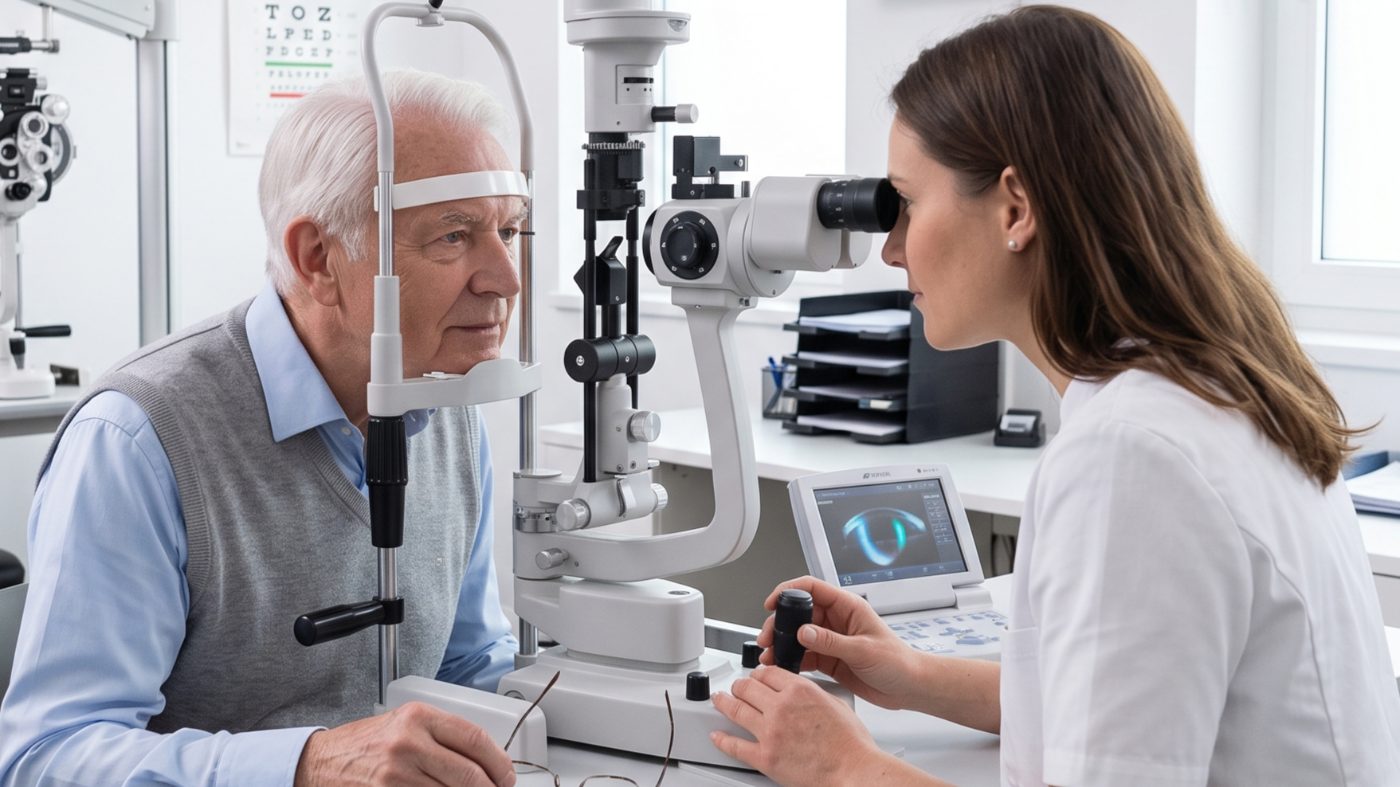
Biometry before cataract surgery: why the measurement matters
“How do you actually know what power my new lens needs to be?” Eye surgeons hear this question before almost every operation for cataract (clouding of the eye’s natural lens). The answer comes from biometry: a painless measurement of the eye. From its values, your eye doctor calculates the right power for the artificial lens. This measurement plays a major part in how sharply you will see without glasses after surgery.
This article explains what is measured, how the examination works and why no operation should go ahead without it.
What biometry actually measures
A special device records several values of your eye. These include the length of the eyeball, the curvature of the cornea and the depth of the anterior chamber. Each of these values affects how strongly the artificial lens needs to bend the light.
From these measurements, a formula calculates the optimal lens power for your eye. Modern calculation formulas take several values into account at once and are considered very reliable today.
The measurements also have an indirect influence on the choice of lens type. They show, for instance, whether your eye is suited to certain lens types such as toric or multifocal lenses. Pronounced astigmatism, for example, speaks in favour of a toric artificial lens.
How the measurement works
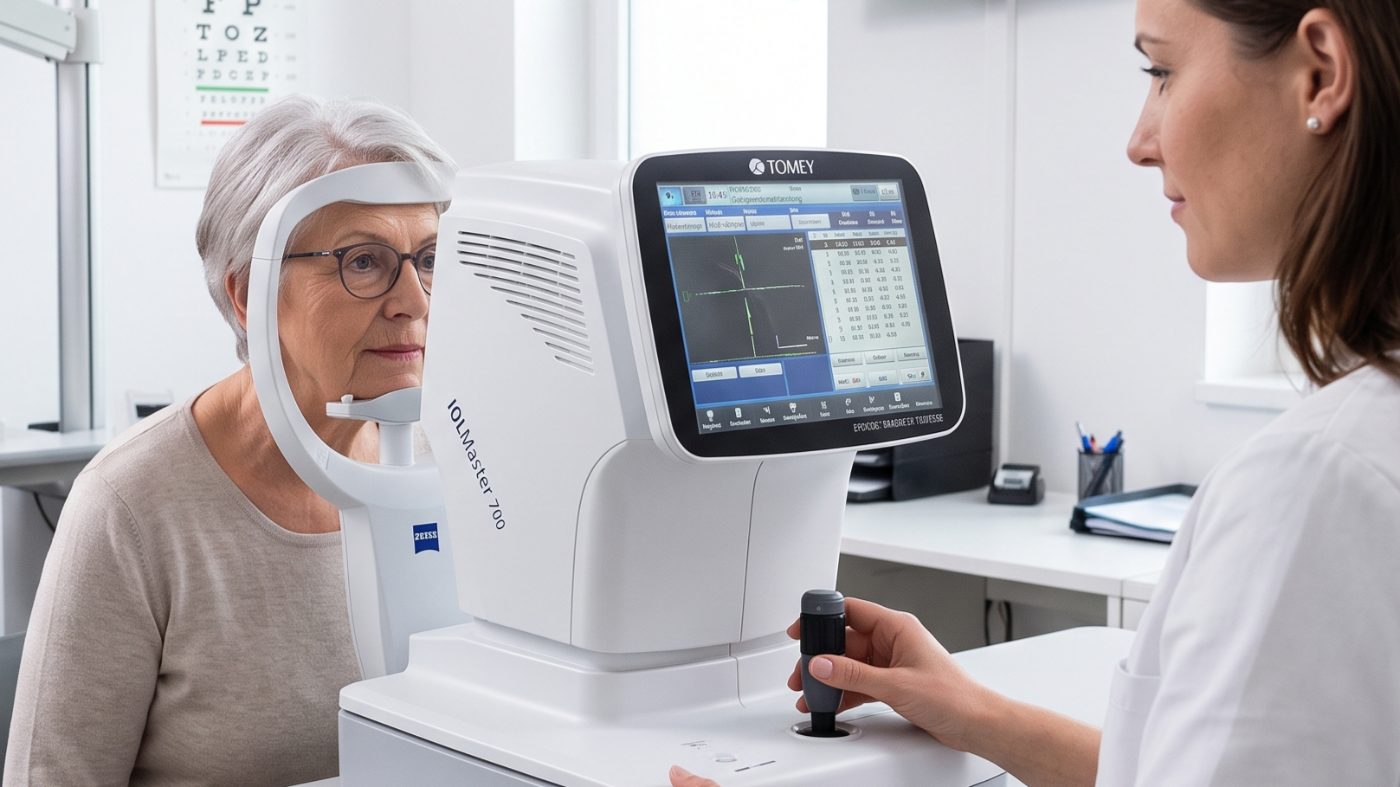
Optical biometry is used most often, frequently referred to as the IOL Master. It works without touching the eye, using light waves, and takes only a few minutes. You simply look into a device, much like during other examinations at the eye clinic. No special preparation is needed, just allow enough time for the whole preliminary examination appointment.
With a very dense cataract, the light sometimes cannot pass through the lens well enough. In that case your eye doctor uses ultrasound biometry. A small probe gently touches the surface of the eye. Both methods deliver reliable values for the calculation.
An example from everyday practice: in a patient with a very advanced cataract, the optical measurement could not be completed at first. The subsequent ultrasound biometry still delivered all the necessary values. So the examination remains reliably possible even with dense clouding.
From measurements to lens power
Specialised software calculates the right lens power from the biometry values. Several calculation formulas are available for this, such as Barrett Universal II or Holladay 2. Which formula fits best also depends on the individual length of the eye. With a very short or very long eyeball, for instance in strong farsightedness or shortsightedness, your eye doctor deliberately chooses a formula suited to it.
The calculation needs particular care after previous eye operations. Anyone who has had laser vision correction, such as LASIK, has a differently shaped cornea than an untreated eye. Standard formulas can become slightly less accurate as a result. So do tell your eye doctor if your eyes have already had laser correction or any other previous operation. This information feeds directly into the choice of formula and can make the result noticeably more accurate.
With a very advanced cataract, a potential acuity test can also be useful. It estimates what visual acuity is realistically achievable after surgery, independently of the lens clouding itself.
The target refraction: setting your vision goal
Before the operation, you and your eye doctor agree on the so-called target refraction. This means deciding together at which distance the operated eye should see most sharply after the procedure. Most people choose distance vision as their main goal.
Some patients deliberately opt for slight shortsightedness or for monovision. This decision depends on your viewing habits and your occupation. Biometry provides the data needed for it.
So describe your everyday habits openly, for example a lot of screen work, frequent reading or regular driving. That way you can jointly find the target refraction that fits your life.
Why accuracy matters so much here
Even small measurement inaccuracies can lead to a deviation from the desired visual acuity. For most patients, the result comes very close to the target. In a smaller group, a slight residual refractive error remains, which can be corrected with glasses.
For this reason, biometry counts as one of the most important steps of the whole preliminary examination. It should never be skipped or replaced by an older, less accurate method.
For people with cataracts in both eyes, the operation on the first eye brings an additional advantage. The actual result can be compared with the calculated target. If it deviates slightly, your eye doctor can factor this experience into the calculation for the second eye.
Frequently asked questions
Does the biometry measurement hurt?
No, optical biometry does not touch the eye at all. Only the rarer ultrasound method gently touches the surface of the eye, but it is painless.
How long before the operation does biometry take place?
Usually a few days to a few weeks beforehand, as part of the preliminary examination. This leaves enough time to order the right lens.
Does biometry have to be done separately for each eye?
Yes, both eyes are measured separately. Even when both eyes have a cataract, their values often differ slightly.
What happens if the result is not exact despite biometry?
Small deviations can usually be corrected with glasses. In rare cases, your eye doctor will discuss further options with you.
Do I have to stop wearing contact lenses before biometry?
Yes, you should pause soft contact lenses a few days beforehand, rigid lenses usually for longer. Your clinic will give you precise recommendations.
Next steps
Which other examinations belong to the work-up before surgery is covered on our page about the preliminary examination. How the right artificial lens is chosen is explained under intraocular lenses.