Driving with cataract: when does it become dangerous?
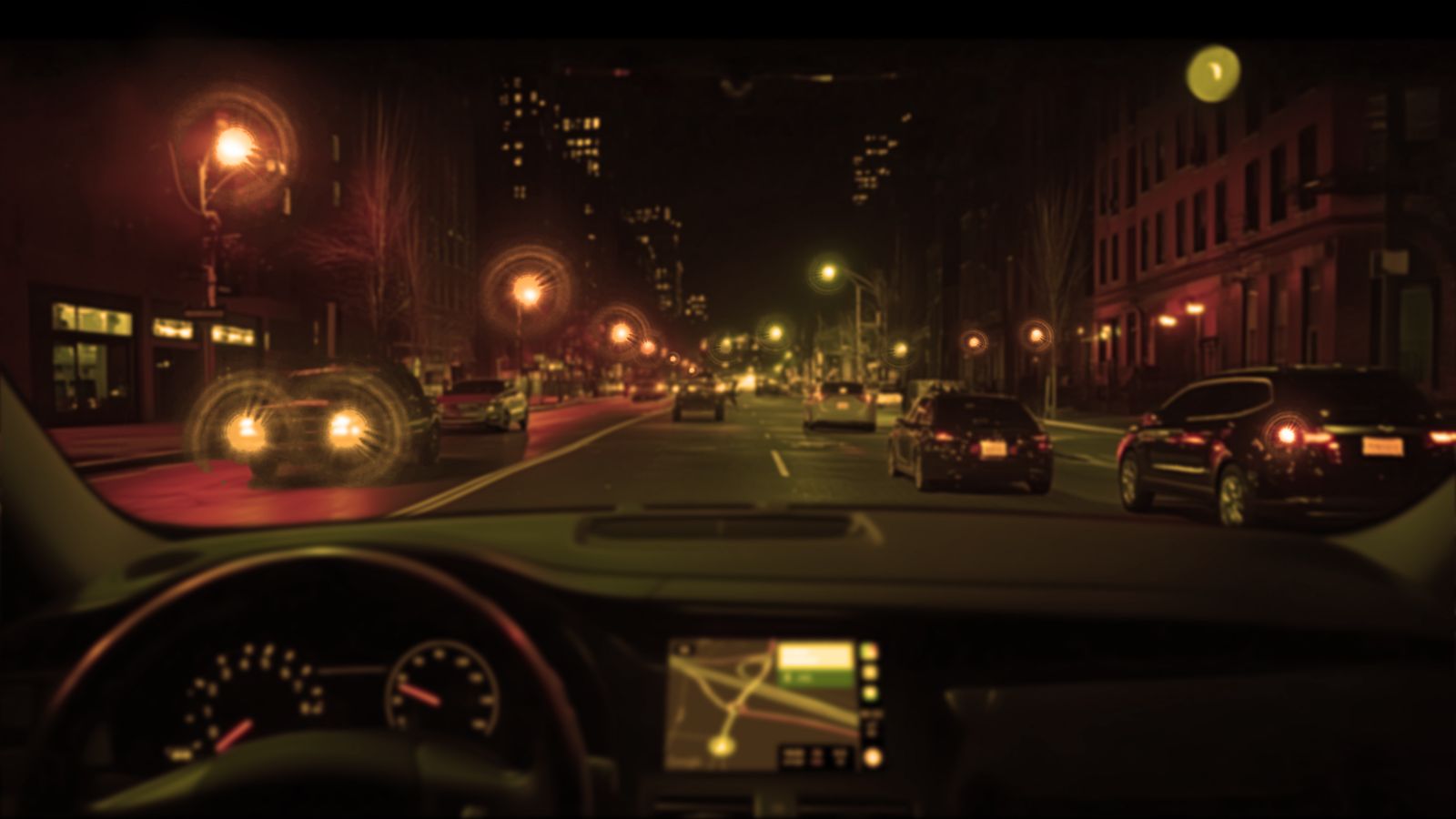
Many people first notice a cataract behind the wheel. Headlights dazzle more than they used to. Road signs look blurred. Driving at dusk becomes an effort. These are not minor annoyances, because they affect your safety and that of others.
This article explains how cataract (a clouding of the eye’s natural lens) affects driving, which rules apply in Austria and at what point surgery makes sense.
Why vision declines behind the wheel first
With a cataract, the lens of the eye slowly becomes cloudy. Light is no longer focused sharply but scattered instead. It is precisely this scattering that stands out in road traffic.
At night, bright headlight beams hit the clouded lens. Instead of a clear point of light, you see a glowing haze with rings around it. Specialists call this glare and halos. For a brief moment, you lose your overview of the road.
Contrast suffers too. A pedestrian in dark clothing stands out less against the background. Rain or fog makes the effect worse. In daylight and under good lighting, none of this may be noticeable yet. That is exactly what makes it treacherous.
An everyday example: on a wet motorway at the onset of dusk, oncoming traffic, reflectors and lane markings blend into a tangle of light that is hard to unravel. Situations like these are exactly what affected drivers report most often.
Why contrast vision matters more than a standard eye test
An ordinary eye test at the licensing office or optician mainly checks visual acuity under good lighting. With a cataract, these values often stay stable for longer than contrast vision and glare tolerance do.
That explains why some people still formally reach the required visual acuity yet feel unsafe at the wheel, especially at dusk or in the rain. The eye test alone does not fully capture this difficulty.
An ophthalmologist can use targeted examinations, for instance at the slit lamp, to determine how much the clouding of the lens already affects contrast vision. This assessment often says more about your actual fitness to drive than the bare visual acuity figure.
If you feel unsure while driving even though your last eye test was unremarkable, that is a good reason for an additional check-up with an eye specialist.
These signs deserve your attention
Watch out for specific everyday situations. The following signs point to vision loss caused by cataract:
- Oncoming headlights dazzle you strongly and for a long time.
- You see rings or starbursts around light sources.
- You recognise road signs only at the last moment.
- You avoid driving in the dark of your own accord.
- New glasses no longer bring lasting improvement.
If you recognise yourself here, have your eyes examined. The test takes only a few minutes and gives you clarity.
What does Austrian law require?
For a Group 1 driving licence (cars and motorcycles), a minimum visual acuity is prescribed. The Austrian driving licence health regulation (§ 7 FSG-GV, the health ordinance under the Driving Licence Act) requires a visual acuity of at least 0.5 with both eyes together, with or without a visual aid. If you only reach this value with glasses or contact lenses, you must wear the visual aid while driving. An ophthalmologist or optician can measure this reliably.
The principle behind the rule matters most. Anyone who notices that their eyesight is no longer sufficient must not sit behind the wheel. This applies regardless of when the next licence check is due. You carry responsibility here for yourself and for others.
The good news: after successful cataract surgery, most people regain the required visual acuity. Many see better afterwards than they have in years.
When does surgery make sense?
There is no fixed threshold at which an operation becomes mandatory. What counts is how much you feel restricted in everyday life. If driving at night has become a burden, that is a clear signal.
During surgery, the clouded lens is removed and replaced with a clear artificial lens. The procedure is carried out as an outpatient and usually takes only 10 to 20 minutes. Within a few days, many patients notice how clear and rich in contrast their vision has become again.
Some people additionally choose a lens that compensates particularly well for glare. Which lens suits you depends on your eyes and your habits. You discuss this with your surgeon at the preliminary examination.
Frequently asked questions
Am I still allowed to drive with a cataract? Yes, as long as you reach the required visual acuity and feel safe. As soon as you notice that you can no longer see reliably at night or against oncoming lights, you should stop driving and see an ophthalmologist.
Does night vision improve after the operation? In most cases, clearly. The clear artificial lens barely scatters light any more. Glare and halos decrease noticeably.
Do I need to take a break from driving after the operation? Yes, for a short time. Your surgeon will tell you when you may drive again. Usually this is after a few days, once the eye sees stably.
What applies if I have a cataract in one eye only? For fitness to drive, what usually counts is the visual acuity of both eyes together. A markedly weaker eye can be partly compensated by the healthy eye, provided the combined acuity is sufficient. If in doubt, an ophthalmological examination clarifies your exact situation.
Should I have my fitness to drive checked voluntarily if I am unsure? Yes, a voluntary eye test at an ophthalmologist or optician quickly gives you clarity. It is straightforward and protects you and other road users.
Next steps
Take warning signs at the wheel seriously. A simple eye test shows whether a cataract is behind them. If you would like to know more about how an operation proceeds, you will find the details on our pages about the preliminary examination and the surgery procedure.