Monofocal lenses in detail: who they are the right choice for
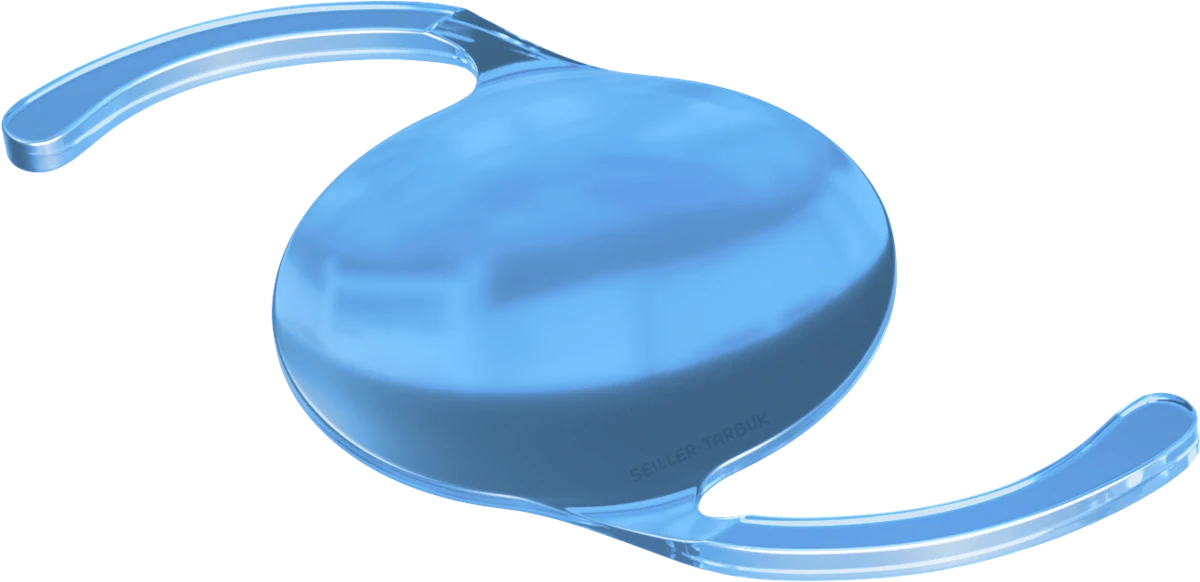
A monofocal artificial lens focuses light sharply at exactly one distance, usually far away. It offers the best contrast and the lowest risk of glare. For near tasks, such as reading, glasses remain necessary afterwards.
This article explains how monofocal lenses work. It also shows who they are the right choice for.
How a monofocal lens works
The natural lens of the eye can change its shape. That is how it switches between near and distance vision. This ability is called accommodation, and it is lost with cataract (a clouding of the eye’s natural lens). A monofocal lens therefore has only one fixed focal point.
Usually this focal point is set for distance. You then see sharply into the distance without glasses. That helps with driving or watching television, for example. For near tasks, such as reading or using your phone, you will need reading glasses afterwards. Some patients choose near vision as the target range instead. That is worthwhile if it matters more to them in everyday life.
The aspheric version as the modern standard
Most monofocal lenses used today are aspheric. Their surface compensates for small imaging errors known as spherical aberrations. These errors would otherwise reduce contrast, particularly at dusk. As a result, vision in dim light is clearer than with older lenses.
Aspheric monofocal lenses are considered the standard of care today. Most patients receive this lens type during cataract surgery.
Advantages over multifocal lenses
Monofocal lenses have a clear advantage in contrast vision. All the incoming light is concentrated on a single focal point. No light energy is lost to additional focal planes.
This is particularly noticeable in poor lighting, for instance at dusk or in fog. The risk of halos, meaning rings of light around lamps at night, also drops markedly. People who value precise vision in everyday life benefit especially. Many of these patients do not find reading glasses a nuisance.
Who monofocal lenses are the right choice for
Monofocal lenses are particularly suited to people who:
- do not find reading glasses a burden in everyday life.
- place great value on the best possible contrast vision, for instance when driving at night.
- already have certain retinal or corneal conditions.
- prefer a simple, well-proven option with no adjustment period.
Some people want to wear glasses as little as possible. In return, they accept small compromises in contrast. These patients also look into multifocal or EDOF lenses (extended depth of focus).
An example: a tradesman who works outdoors a lot, in changing light, often benefits particularly from the high contrast of a monofocal lens.
Toric monofocal lenses for corneal astigmatism
Some people have astigmatism (an uneven curvature of the cornea) in addition to the clouding of the lens. An ordinary monofocal lens does not compensate for this curvature. The image then remains slightly distorted in certain directions even after surgery.
For this situation there are toric monofocal lenses. They have different refractive power along different axes and thereby correct the corneal curvature directly. From a curvature of about one dioptre, such a lens often becomes worthwhile.
Exact alignment in the eye is what matters. Toric lenses carry markings that guide the surgeon during the procedure. A slight later rotation of the lens can weaken the correction, but modern models are very rotationally stable.
Whether a toric version is an option for you depends on the extent of your astigmatism. A measurement of the corneal curvature during the preliminary examination settles this.
Monovision as a middle way
Monofocal lenses can still offer some freedom from glasses, using a method called monovision. Here the surgeon sets one eye for distance and the other for near vision. The brain learns to combine both images. It favours the sharper eye as needed.
This approach does not work equally well for everyone. A prior trial with contact lenses shows whether you tolerate this way of seeing. That lets you decide for or against this option on an informed basis. Raise your expectations about life without glasses openly at the preliminary examination, so the surgeon can set the right target refraction for both eyes.
Frequently asked questions
Can I do without glasses entirely with a monofocal lens? For the chosen distance, usually far vision, this often works. For other distances, such as reading, you will still need glasses. Deliberately chosen monovision is the exception.
Is a monofocal lens worse than a multifocal one? No, it pursues a different goal. Monofocal lenses offer the best contrast vision and the lowest glare risk. Multifocal lenses offer more independence from glasses at somewhat reduced contrast.
How long does a monofocal artificial lens last? No expiry limit is known. The lens normally stays in the eye for life. A replacement rarely becomes necessary.
Can I still choose a different lens later? You make the lens choice before the operation together with your ophthalmologist. A later exchange is possible in principle. It remains, however, an additional procedure with its own risk.
What happens if I also have astigmatism? Then a toric monofocal lens may be an option, correcting this curvature at the same time. Whether that makes sense is shown by the measurement of the corneal curvature at the preliminary examination.
Does the sharpness of a monofocal lens change over time? No, the set refractive power remains stable. Unlike the natural lens in younger years, an artificial lens cannot adjust to different distances.
Next steps
You will find an overview of all lens types on our page about intraocular lenses. How the lens choice is made during the preliminary examination is described under preliminary examination.